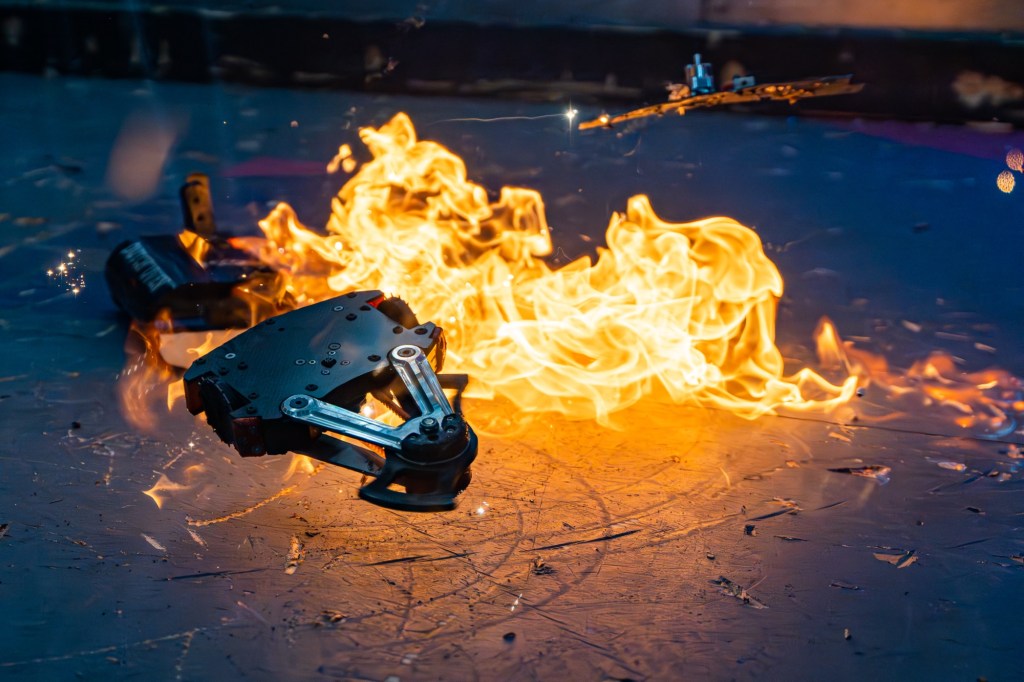
Project Summary:
This bot was created and iterated on during the last two years since my introduction to combat robotics through UCSC’s Slugbotics. This robot was a redesign of the clubs 3lb bot that I designed in both Solidworks and Onshape, with manufacturing processes including CNC machining and 3d printing. Combat robots are a popular in California and are one of the only opportunities where you can stress test your engineering skills to such a degree. This process involves heavy material analysis and designing to handle high kinetic energy weapons while maintaining various design restrictions

Design Parameters:
- Follow the SPARC ruleset per weight class
- Modality for different opposition weapon types
- Machined in house excluding steel lasercutting and carbon fiber
- Designed to fully assemble in 10-15 minutes
Design Process:
This robot was a version 2.0 of our clubs 3 lb horizontal spinner. This consisted of identifying previous failure points that I would focus on during the ground up rebuild while introducing new engineering techniques for better performance.
These resulted in these specific design choices
- 175mm diameter blade that weighed about 300 grams made of AR 500 steel
- 6S 650 mAh LiPo battery at 22.2V
- neodymium magnets for steel floors to provide better traction
- 3.5mm carbon fiber top and bottom panels
- A toothless belt to prevent motor damage during impacts
- 50 mm custom cut gum rubber wheels
- Glass filled Nylon-6 filament
- Shore 60A TPU filament
- Nylon-12 Chopped carbon fiber filament
- Brushless 1806 2300kv motors with a 22:1 planetary gearbox
With these specifications in mind, the bot came together fairly quickly. When manufacturing began I identified potential material weaknesses in the way we were printing our parts, where the orientation would result in layer separation given our expected impact vectors.
Results:
The bot performed very well after recovering from some initial oversights, at a competition at UCLA it beat out every UCLA/Collegiate robots and placed 2nd overall at the competition. Following this success the club went to competitions across the nation as well as several more in California. We continued to achieve podium placement and at one competition placed 14th against 300+ other robots.

Outside of the placement the robot did very well in terms of speed and handling hits from the opposition, but the robot had limitations in terms of weapon stability that will be improved upon
Future Revisions:
Most of the failures of the bot were self inflicted, and repetitive to the point that it was clear it was a game ending design flaw
- Most significantly was that there was to much play in the weapon bearing stack the horizontal blade was mounted upon. Coupled with the flexibility of the carbon fiber near the weapon mount, the blade would angle farther than expected and would bite into the carbon fiber, almost shearing off the weapon mount itself. To fix this I want to explore reinforcing the carbon fiber with aluminum, as well as increasing the diameter of the bearings the weapon is mounted on. This will most likely prevent an over angling of the blade because the bigger diameter bearings will impact the top or bottom carbon fiber before the blade has a chance to penetrate.
- Additionally the magnets we implemented were not adjustable in any way. When we entered the arena the magnets were too powerful and essentially locked the robot to the steel floor. A temporary stopgap we implemented was electrical tape, but in the future I will recess the magnets to increase distance to the steel floor.
- Lastly, our TPU armor was very heavy and seemed to provide a lot of material to bite when impacted. I want to try implementing a lower infill armor package that will transfer less force on impact. This has the draw back of the armor being more likely to take damage, but the internals of the bot and structural integrity will remain stronger.
Acknowledgements:
This bot was made as part of the UCSC slugbotics team. During the process I was mentored by the designer of the previous version of the bot who taught me cad design and combat robot fundamentals. Currently I co lead the combat robotics team in making more bots to hopefully win more competitions.
 Merrick Fort